BlogHer

Saturday, April 16, 2016

Nostalgic Reflections—Getting To Know Me


Something I heard last week sent me into flashback mode. It brought to mind words people used to describe me years ago. I realized most folks who know me today would never guess that the phrase referred to me, which in turn led me to create a quiz based on my nostalgic reflections.

Think of this exercise as a way to get to know me. If you like the game, feel free to use it with your friends and family to learn about each other. Answers (True or False unless otherwise noted) and amplifications are provided at the end of this post. Apologies in advance if any of it grosses you out.

Things People Used To Say About Me
1.     She probably sleeps with a coding manual under her pillow.
2.     Her normal expression is half way between neutral and negative.
3.     I bet she’s really a blonde and dyes her hair brown to look smarter.
4.     Ask her what time it is and she’ll tell you how a watch is made.
5.     She has brass __________. (Fill in the blank.)

Things I Did On A Dare As A Kid
1.     Tackled and kissed a boy on the school bus.
2.     Ate a freeze-dried worm.
3.     Pooped in the woods.
4.     Stole a tube of Tangee orange lipstick from F. W. Woolworth’s.
5.     Rode my sled down the steep “boys’” hill.

Nicknames People Had For Me Over The Years
1.     Bugle Butt
2.     Elaine the Pain
3.     Imelda Decker
4.     Sax Kitten
5.     Suzy Potts

Answers and Amplifications

Things People Used To Say About Me
1.     Sleeps with coding manual… True. My first career was in computer programming and systems, and my colleagues acknowledged that I was damn good at it.
2.     Expression between neutral and negative… True. I was extremely focused and serious. This trait kept me from being mugged on my daily walk from the Port Authority to Colgate Palmolive and back.
3.     Really a blonde… False. I’ve never been accused of trying to look smarter. In fact, I tried bleaching my hair with peroxide when I was in seventh grade.
4.     Ask what time and get a watch… True. My colleagues thought I answered everything in too much detail.
5.     Brass __________. Balls. Could there be any other answer?

Things I Did On A Dare As A Kid (Can you tell I was a tomboy?)
1.     Kissed boy on school bus. True. It was a wood paneled station wagon. I pinned him on the floor while I planted a wet one. There was a lot of cheering.
2.     Ate a worm. False. This is sort of a trick question. While I didn’t eat a freeze-dried worm, I did eat a fried grasshopper on a dare. It wasn’t all that bad.
3.     Pooped in woods. True. It was a struggle; I couldn’t even fart on cue, but I was determined to win the dare.
4.     Stole lipstick… False. Orange Tangee was my color, but I didn’t steal a tube. Weekly confession was an effective deterrent.
5.     Sledded down the “boys’” hill… True. I crashed into bramble bushes and cut my wrist on the runner. (Defective steering mechanism.) But I earned kudos from the boys—the same ones who dared me to kiss on the bus and poop in the woods.

Nicknames People Had For Me Over The Years
1.     Bugle Butt. True. This was given by one of my college boyfriends and whatever you’re thinking is probably correct. He had an odd skill: he could play the trumpet using just his mouth. I told myself that explained his affection for brass wind instruments. If only we had Sir Mix-A-Lot in the sixties. “I like big butts and I can not lie.”
2.     Elaine the Pain. True. No explanation needed.
3.     Imelda Decker. True. I had about 50 pairs of shoes. One lunch break I bought five pairs at Saks Fifth Avenue (just a block from Colgate Palmolive). I got two each of two styles of Mary Jane heels, in four luscious colors. The fifth pair was navy T-straps. Imelda Marcos had nothing on me.
4.     Sax Kitten. False. I played alto sax in high school, and there were jokes about sax appeal, but never a nickname.
5.     Suzy Potts. True. My parents called me that. At least, I thought they did. Turns out they were saying “you’re crazy” in the Italian dialect of my mother’s family. I misunderstood and they let me think it was a term of endearment. I signed cards to them “Love, Suzy Potts” even after I learned the truth.

Give yourself 5 points for each correct answer. If you scored over 55, you’re a good friend. Seventy or above makes me suspicious that you skipped to the end.

Saturday, April 9, 2016

Election Alphabet


The primaries leading up to the Presidential election this Fall have created a new lexicon of media vocabulary. See how many words and phrases in my Election Alphabet you’ve heard or read during the campaigns. Don’t be surprised to see a second edition of this at year-end.

A You’re no longer adorable; you’re abhorrent, especially if you’re Trump’s policy about banning Muslims from entering the U.S.
B Bombastic, a bully, a bigot and a blowhard. Only one candidate has earned all these monikers.
C A carpet bomb is not an ugly rug made in the Middle East. Like Raid, it involves an aerial assault to eradicate vermin at ground level.
D Is for divisive and disgusting, the former frequently used to describe Trump’s rhetoric, and the latter being his go-to word for anything his rivals do or say to offend him. But my favorite election d-word is demagogue. That’s because it transforms so easily into demigod, which has me picturing Trump grunting: “Me God, You Jane.”
E Candidates positions evolve during a campaign. Evolution is how one candidate tries to out-flank his or her opponents. Often the state holding the next primary is a deciding factor in how much a candidate evolves. And in which direction.
F Fingers are the new measure of someone’s manhood. In my salad days it was feet. I suppose it’s good to know what our candidates’ hands are up to.
G Pay attention to what’s happening at the grass roots level and to the ground game. Do not confuse these with gray roots or ground hogs. Or Colorado’s grass game.
H Two of Trump’s favorite words—huge to describe everything he’s going to do (and his fingers, apparently) and horrible to characterize his opponents.
I More monikers for you-know-who. Irrational, ill-informed, irascible and irritating.
J Is for Japan. See Nuclear Triad (Donald Trump’s).
K Kerfuffle describes a back-and-forth between candidates that’s reported in the media. Both parties fuel kerfuffles, especially during political talk shows.
L Labels Trump uses for his opponents—low-energy (originally stuck on Jeb Bush, now transferred to Hillary) and liar, liar, pants on fire (slapped onto Lyin’ Ted Cruz).
M A movement to engage first time voters, such as Bernie’s Democratic Socialism and Trump’s White Supremacy.
N Nuclear triad—land, sea and air; or in Trump’s case—North Korea, South Korea and Japan.
O A trio—obfuscating, obstructionist and outsider—that describes a number of candidates. “Outsider” is supposed to be a badge of honor. The question is whose chest it truly belongs on.
P Some pairings. Polls and primaries, in which the former seldom predict the results in the latter. Also persona and presidential, meaning Trump’s primary shenanigans are simply a persona he took on to fire up supporters. He assures us that when he’s elected, he’ll be more presidential than anybody.
Q The early Republican debates were quarrelsome, querulous and quirky.
R Is for Rat-f—ker, a peculiar descriptive employed by Ted Cruz. It was intended to explain what he’d rather do with a rodent than with Donald Trump. Wasn’t “none of the above” one of the choices?
S Stands for sycophants and suck-ups, two ways to portray the same people. They make up that concrete floor of Trump supporters.
T Has to be Twitter, Trump’s main form of communication with his sycophants and suck-ups. His tweets may set the Twittersphere on fire, but 70% of women say he doesn’t light theirs.
U Uninformed is what Trump is on foreign policy (see his nuclear triad). Don’t panic. He’ll be OK if you give him an earbug with Hillary on the other end.
V Trump’s tweets go viral. This is not the same as virile. Someone please tell Donald.
W Walk-back—the latest way to describe a candidate’s change in position on an issue, because “evolve” doesn’t always cover it. Trump walked back his stance on punishment for illegal abortions several times. I can’t leave the letter W without mentioning wives. Trump and Cruz got into a kerfuffle over whose wife made prettier arm candy. I suppose that’s better than arguing over whose hands are bigger.
X No, a xenophobe is not a musical instrument. The hatred of foreigners strikes a sour note, even when it’s masquerading as nationalism in the Republican primary.
Y Yuge is the phonetic spelling of Trump’s favorite word to describe his accomplishments (and probably his hands). A Yugo, on the other hand, is a defunct car. The Yugo was not yuge and was the butt of many jokes. Draw your own conclusions.
Z Zero is the chance of election vocabulary becoming civilized any time soon.

Saturday, April 2, 2016

Hoarding vs. Collecting


A recent local news item reported on an elderly man who perished in a fire in his home. Firefighters had difficulty controlling the blaze because the man was a serious hoarder. The house was filled with papers and other combustible material. He also had a gunshot wound, but there was no follow up on how that might have been a factor in his demise.

As I listened to this story, I glanced around our family room and wondered: How do you know whether what you’re doing has jumped the shark from being just “collecting” to being “hoarding?” My husband has stacks of papers, catalogs, direct mail fliers, and books he has either been given or has purchased (sometimes from offers in those fliers). He would probably never throw any of this out if I didn’t nag him about it periodically. (Pun intended.)

I’ve always been a collector. I don’t think I’m a hoarder, but I’m not yet in my eighties. Is hoarding lurking in my future? One of my earliest blog posts dealt with my collecting habits. “I always felt that one of something was lonely and needed a friend. Once I made the pair, I was sunk. Because whenever I came across another related item, I was compelled to bring it home to introduce it to the others.”

I was forced to jettison some things when we downsized, but visitors to our condo who never saw our house in Providence would find that hard to believe. I’ve come up with various ways to display my collections that should dissuade anyone from calling them hoarding. For instance, I’ve arranged my antique evening bags (13) and gloves (11) in four shadow boxes. Scattered among them are old compacts (8), buttons (8) and circle pins (9), thus making these boxes objets d’art hanging on the living room wall.

I still fall victim to the urge to begin new collections. When I started playing the saxophone again, I decided to get some Christmas ornaments of figurines playing saxes. That evolved into cats playing them even though they weren’t suitable to hang on a tree. After the holiday, I expanded my search techniques and stumbled across clowns playing them, too. I also discovered that some sellers misspell the instrument as “saxaphone,” which doubled the number of searches I made.

Two months and many EBay surfing hours later, I have: 3 cats playing sax (Felix is earmarked as a Christmas gift for my instructor); a tiger, an alligator and a sheep all also playing the horn; a clown playing sax and one with a concertina (they were sold as a pair); and cats playing bass fiddle and drum—too cute to pass up, even though there was no sax player in the group. Besides, I’m now jamming in a small combo, so why shouldn’t I celebrate that?

I had to move my collection of miniature teacups and saucers from the display shelves to make room for the band menagerie. They’ll still require dusting in their new locations, so I plan to sell them on EBay. Since that money will wind up in my PayPal account, I’ll probably use it to buy more must-have finds for my musical menagerie. Note to self: look for animal piano player.

As I write this, it’s evident that there are some gray areas in my defense of my collecting addiction. And yes, I just used the word “addiction.” I admit that a collecting addiction is probably just a few glasses of wine away from a hoarding disorder. NBC had a feature this week on the “Sip and Click” phenomenon. It’s the habit people have of coming home after a late evening of drinking with friends, logging on to their computers and buying all sorts of things they don’t need and wouldn’t buy if sober.

I’m not in danger of that happening, but there’s one hoarding habit for which I’m probably at risk. That’s becoming a Crazy Cat Lady. We recently adopted a senior cat from a local rescue shelter. We had picked out a senior brother for her, but he has developed health issues that could be too serious for him to be adoptable. If he recovers, we’re definitely taking him, but it could be weeks before that’s resolved.

In meantime, our new girl is in need of some company (besides me). That could mean we’d be back to three cats at some point, which is where we were when we had Pansy, Lily and Luke. I look at the shelter’s website every day to see who else has shown up. “Oooh! That one’s so cute. But she’s too young. I want an older cat.” Lord help me if they ever get several seniors surrendered at once.

Saturday, March 26, 2016

The Age of Final Goodbyes


This week we buried my dear friend Charlie Schneider. His death was expected. Given the cocktail of ailments that plagued his final months, it was one of those passings that truly was a blessing.

Charlie’s funeral was the third that I learned of from a friend or colleague in as many days. The burial itself brought home the fact that I was saying my final goodbye to my friend of forty-five years. It occurred to me that when I entered my seventh decade, I also entered the age of final goodbyes. Charlie was the third one of my Colgate MIS colleagues who died within the past year.

That number three again. One often hears that death comes in threes, but of course it comes in much larger numbers, depending on the time span covered. Some consider three to be a mystical or sacred number—The Holy Trinity, for instance. Or a lucky one—three coffee beans in a glass of Sambuca Romana after dinner. Not one, not two; always three, if you want good luck. Third time’s the charm and all that. My mind fixated less on the number than on the finality of the parting.

For me the process of saying goodbye to Charlie included going through old photo albums. I was looking for pictures that I could post in the guestbook for his obituary on legacy.com. So sad to see his smile again, and to remember where the photos were taken. At my parents’ fiftieth anniversary party, for instance. My father and mother have been gone for 32 and 20 years respectively.

A photo of Charlie and me with my mother between us, taken one summer at the home where I grew up in Green Pond, was especially painful. Charlie had his summer tan and we were all smiling and happy. We sold the house after my mother died and it has since been remodeled. Green Pond has changed. Some of my summer friends still gather for lunch now and then, but not at the lake. Not anymore. The intersection of all that loss increased my grief geometrically.

I was forced to look at the faces in those pictures for quite awhile. They needed to be scanned into my computer, shading and resolution adjusted in Photoshop. I decided to crop myself out to focus on Charlie. Then they had to be put on a thumb drive and transferred to the computer with an Internet connection. Then uploaded to legacy.com. It sounds mechanical and robotic, but when I looked at the faces, it was anything but. Many tissues, red nose and puffy eyes later, I was finished.

At the luncheon after Charlie’s funeral, that final goodbye behind us, it was time to share memories of what made Charlie special. Some of those memories were similar, even though they came from different pockets in his life. We all knew about his love for trains, for example, reflected in his extensive model train collection. And most knew that he grew to love trains by watching them on the track behind his grandmother’s house. She took care of him while his mother was at work.

I thought about that on our drive home. A seldom-used freight track runs through the wooded area on the opposite side of the fairway behind our condominium. A train makes one trip some weekday mornings, going in and coming out. The engine rumbles so deeply that I hear it well before it comes into view. I call out: “Here comes the train!” and run to our porch to watch it go by.

My joyful routine makes my husband laugh. Even before Charlie died, I would say to Jagdish: “Now I understand why Charlie loves trains so much.” And so, despite the final goodbye having been said, I will remember my dear friend fondly whenever I hear a train roll by. I will smile and perhaps wipe away a tear. Then I’ll get back to whatever it is those of left behind do with the days we have left.

Saturday, March 19, 2016

Can Trump “Fix It In the Post”?


Creative types will be familiar with the phrase “fix it in the post.” It usually means that problems in the shooting of a video or a film will be corrected in the post-production (or edit) phase of the project. Without getting too deep in the weeds, here’s an example. The lead actor has a long stretch of dialogue and keeps messing up one piece of it. After many takes, the director may say his final “cut” and decide to “fix it in the post.”

The actor will record just the problem line in isolation in a studio booth. The director will be sure to have a cut-away in the can of a close-up of someone listening to the actor’s dialogue. He’ll also have some ambient sound recorded on the set that will be married with the line done in the booth so it meshes with the rest of the speech. The fixed line will be edited into the footage under the cut away shot of the listener.

Many Christians also subscribe to a concept of fixing things in the post. They call it purgatory. That’s where souls go to atone for sins so they are purged clean enough to pass through the pearly gates. Their souls are, in effect, “fixed” post their death.

Now that I have your eyes glazed over, let’s bring this around to the current Presidential election. Some people, even non-supporters, believe that Donald Trump’s antics and vulgarity throughout the primary are simply part of his campaign persona. Trump himself claims that he can be “more presidential” than anyone. Thus far he’s shown little capacity and even less inclination to moderate his extremism. He continues to fuel divisiveness with angry rhetoric.

There’s anger and the potential for violence on both ends of the political spectrum. At one recent rally a 78-year-old Trump supporter cold-cocked a protester who had been subdued and was being escorted out by several security guards. At another event, a left-wing protester stormed the podium and was grabbed by Trump’s Secret Service agents.

Irrational speech and behavior is not new. Nor is concern about the potential consequences. When Obama was elected President, some of his supporters worried that he would be assassinated before his term was up. Fortunately, that worry has proved unfounded despite the constant vitriol that surrounds him.

If Trump is elected President, he’ll have a chance to self-edit and fix his rhetoric and his behavior in the post (election). If he doesn’t do this, someone in the lunatic fringe on the left might be provoked to fix it for him. Here’s another Christian concept to consider (King James version): whatsoever a man soweth, that shall he also reap.

Saturday, February 6, 2016

Technology Run Amok


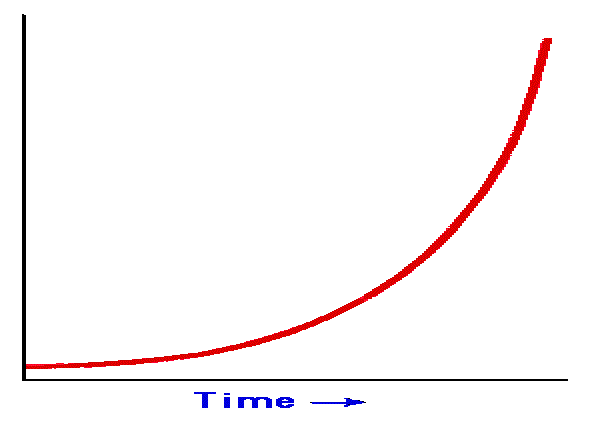
My husband, Jagdish, and I are intrigued by the concept of singularity. Technological capabilities have been increasing exponentially over many decades. If you graph this, you get a swoosh that eventually goes up to vertical infinity (my term). In his 2001 essay, The Law of Accelerating Returns, Ray Kurzweil tells us: “Computer speed… doubled every three years between 1910 and 1950, doubled every two years between 1950 and 1966, and is now doubling every year.”


I can see your eyes glazing over, so let me cut to the chase. When the singularity arrives, AI (artificial intelligence)—e.g. computers and robots—will be able to build versions of themselves that are even smarter than they are, and by extension, smarter than we are. That means we won’t be able to understand them, much less control them. Scary stuff.

In other technological news, computers have been hooked up to Etch-A-Sketches to design things and recent medical developments include using 3-D printers making custom knee replacement parts. My sister had one of these put in last week. My mind is whirling with the possibilities of what will happen when AI that has outpaced us in intelligence gets hold of an Etch-A-Sketch and hooks that up to a 3-D printer.

Computer programmers will be familiar with the acronym GIGO—Garbage In, Garbage Out. It means that what you get out of a computer is only as good as what the programmer and the data entry clerk have fed into it. It stands to reason that the end products of the singularity triad I envision will reflect the interests of the people who have set them in motion. Here’s what I expect mine to do for me.

Colleagues from my Colgate Palmolive days will expect that the first thing I’ll get out of my singularity threesome is a closet full of shoes. They called me Imelda Decker back then, and though I don’t need business shoes now that I’m retired, I still have a closet fool of footwear. I counted twenty pairs just of black dress shoes in there.

I’d also like to have a posse of cats of every breed and color combination. They must be bred to be free of disease and genetic glitches, so they’ll live a very long time. They should also be trained to change the litter box themselves. And of course, they must be able to purr in harmony. We wouldn’t want a cacophony in the household.

Now that I’m hooked on playing the saxophone again, it would be convenient to have my own jazz group. My AI trio will create instruments that play themselves, so I won’t have to worry about coordinating folks’ schedules. Of course, I’ll always welcome real people to join in; the social side of this is important to me, too. But if the trombone player is sick, we’ll always have a backup.

The singularity should be able to deliver an herb garden with plants that are able to water themselves and that are resistant to bugs. We’ll have fresh thyme and rosemary and basil all year long. I might even learn how to make my own pesto.

Of course, no plans for an intelligent future would be complete for me without a wine cellar. My bot beings would even figure out how to age the wine instantaneously. Free wine of every variety. What a concept! While I’m at it, let’s get bottles that know how to remove their corks by themselves. I’ve tried all kinds of openers and I’m still searching for the perfect corkscrew. The one I liked best finally gave up about six months ago.

The last futuristic development I envision, at least for now, is books of mine that write and publish themselves. There will be an entire wing of the Library of Congress filled with nothing but Pulitzer Prize winning volumes written by me. Or more accurately, by my AI. Using the GIGO concept, if my artificial intelligence writes well, it’s because I programmed it to do that years earlier. I’ll deserve all those writing awards and the royalties that will roll in as a result of them. I hope my singularity comes soon!

For all you know, this blog was written by artificial intelligence already. And it was probably buzzed on a bottle of AI-produced vino

Saturday, January 30, 2016

Disappearing Brands


One of the frustrations of aging is when brands we have favored for years—make that decades—suddenly disappear from store shelves.

It took a long time for me to admit that I should color my hair. Even then it was because I was in job search mode. I was blessed with my mother’s skin, so my gray roots were the “tell” of the years I ‘d shaved off my resumé.

Since my hair is short (and I was also blessed with my father’s Teutonic frugality), I would split a package of hair dye into two uses. I color my roots after each haircut, which is to say every five weeks, so a box lasts me ten weeks. Since I shop the sales, I used to buy two to four boxes at a time. Doing the math on averages, that put me in the hair color aisle about twice a year. I liked to keep a box in reserve, so I’d start looking a month or so before my stock ran out.

Last Summer I noticed that my brand, Clairol Natural Instincts, was frequently on sale, but the slot for my color, #28 Nutmeg, was always empty. Sadly, I didn’t recognize the warning signs of a disappearing brand. By the time my supply ran out completely, not only was Nutmeg missing, but in most stores, Natural Instincts was gone altogether.

Most of my women readers will understand immediately the cold frisson of panic that crept up my spine. What to do? I had chosen NI Nutmeg on the advice of my niece, Pam. “Start with semi-permanent dye until you see how you like it.” And then emphatically: “Don’t get anything with red in it! No auburn overtones. No red undertones. Just plain dark brown.”

Don’t those manufacturers realize the havoc they sow when they discontinue a popular color, much less an entire product line? Since my hair is a lot grayer now than when I started coloring it, I decided to try a permanent brand. That led me to Revlon’s ColorSilk. I wanted to punish Clairol for putting me through this, but I also wanted to stay as close to #28 Nutmeg as possible. ColorSilk offers #27 Deep Rich Brown (no mention of red), so I grabbed one.

That was just the beginning of my hair coloring adjustment process. When I opened the box at home, I discovered that ColorSilk bottles are opaque. Natural Instincts were semi-transparent. By keeping a spare empty on handy, I could easily split the color activator in half. Not so for ColorSilk.

This was getting too involved for my liking. I decided I’d mix the entire bottle this time and throw out whatever was unused. I could picture my father turning over in his grave because of the waste.

It seemed like a good idea to read the instructions for the new product to see what I might have to do differently. The first thing that caught my eye was how long the mix stays on the hair. Half an hour! That’s ten minutes longer than the semi-permanent dye. I can deal with that. There are a handful of things I can do without glasses (which would get hair dye on them). Actually, not a handful. More like one or two, but OK.

Further reading says after you pour the colorant into the activator bottle, be to be sure to shake until the two are well mixed. Hello! The bottle is opaque. How am I supposed to know when they’re well mixed? I counted two minutes, same as for the old product, and hoped for the best.

I kept reading the instructions to find out if any other surprises awaited me. Sure enough. After a half hour I’m supposed to run some water through my hair, gently work the product all the way down to the ends, then immediately wash the dye out.

I’m no expert, but wouldn’t it make more sense to work the product down before the half hour is up? What possible benefit can this work-through have if I’m going to rinse it right out? Turns out, not only is there no benefit, but there’s also added aggravation. Why? Because I’m supposed to keep the protective gloves on for this process.

Let me see if I have this straight. Put the product on my hair. Leave on the dye-stained gloves. Sit motionless for one half hour. Gently do a wet work-through with gloves on. Take gloves off and immediately rinse thoroughly.

I dutifully, if begrudgingly, followed all the steps, and guess whose hair came out with reddish overtones? I think you know who will be buying another brand in five weeks. I’ll probably give L’Oreal a try. Because “I’m worth it.”

Saturday, January 23, 2016

AARP Alcoholics


Based on a quiz in a recent issue of AARP’s magazine, it seems I might be an alcoholic. This won’t come as a surprise to any readers who take my wine-drinking comments literally. But it certainly surprised me, since in truth I consume at most a bottle of wine every two weeks.


There were five questions on the quiz. If you answered ‘yes’ to any one of them it “could be a sign of an alcohol problem” according to AARP. Jeez Louise. I answered ‘yes’ to three of them. I’m a tad confused, because the same article claims that “moderate amounts” of my beloved wine can improve the health of my heart and brain. By now you’re no doubt wondering what exactly was on that quiz. I’ll tell you.

The first question was: Do you ever underestimate how much you drink? Hell yes, I do. I also underestimate how much I eat, how long it will take to get ready to go somewhere, how much I presently weigh and any number of other aspects of my life. About the only thing I don’t underestimate is how many minutes I’ve been exercising each morning.

The second question was: Do you often take a drink to relax, or calm your nerves? OK. So this one was borderline. I don’t drink to calm my nerves; they’re pretty steely most of the time. I do drink to relax, but I wouldn’t say I do that often. So I’ll give myself a pass on this one. After all, I only need one ‘yes’ to be an AARP alcoholic. I already have that and there are still three more questions to go.

Third question: Do you drink to take your mind off your problems? Duh. Doesn’t everyone? I drink to take my mind off everything. A nice, fuzzy buzz feels good. Besides, similar to my estimating skills, I also eat to take my mind off my problems. And I go shopping to do that. And sometimes I even write to take mind off things, which is counterintuitive, since I really need to focus on things when I’m writing.

Fourth one: Have you ever made rules to manage your drinking? This is the most ridiculous question of all. I make rules about everything. And lists. Just ask my husband. So, of course I’ve ever made rules to manage my drinking. That doesn’t mean I pay any attention to them. Regardless, this is another question in my ‘yes’ column.

The fifth and final question was: If you’re lonely, does drinking make you feel better? This one presents a faulty dilemma for me, because I can’t really say I ever feel lonely. Well, that’s not quite true. Living in a cat-free home after about forty years of having those furry joys in my life can get a bit lonely sometimes. I still cry when I think about them but drinking would only make it worse. So this question gets a resounding ‘no.’

That means I’ve scored an easy hat trick on the quiz, making me a triple AARP alcoholic. I was beginning to wonder what I should do about this. Then I noticed the heading of the column to the right of the “Are You Drinking Too Much?” quiz. It was “Mix A Mocktail” and it promised: “The wagon doesn’t have to be dull.” Exactly what goes into a ‘mocktail?’ you may be wondering? Keep reading.

You combine pitted cherries, fresh mint leaves, way too much sugar, lime juice and lots of cherry-flavored seltzer. That sounds like a recipe for becoming a sugar-holic to me. If it’s a choice between wine and refined sweets, I’ll go to with the vino every time. The only real decision for me would be: “Red or white?”

Saturday, January 16, 2016

Liberated by the iPhone


The title of this blog will make sense in a few minutes, but first you need some backstory. Lately when my husband, Jagdish, and I are driving from Connecticut to Providence, we discuss recent happenings on the political front. We analyze which presidential candidate holds what views and what effect his or her policies will have.

On one of the trips we talked about the differences between the tax plans proposed by Bernie Sanders and Donald Trump. One cannot easily do this without touching on the 10% — 90% economic model.

Jagdish was searching for the word for the type of government where a small percentage of people have all the resources and the power over a large group of have-nots. I suggested that would be an oligarchy. He then came up with a plutocracy.

We wondered what the difference was between the two. I wasn’t certain, but I thought that plutocracy was a more generic term for the rule of many by a small group. I believed oligarchy was more specifically the rule by a small group who controlled the bulk of the resources (money and land) of a large group who had virtually nothing. It turns out I had it backwards.

The way we figured this out is how this post came about. Since I’m always the driver, Jagdish set about looking up the definitions of oligarchy and plutocracy on his iPhone. He quickly found the answer and clarified the two for me. A proverbial light bulb lit up above my head.

In years past, when my husband asked what a certain word meant, here is what happened. About 80 percent of the time, I was able to answer his question with certainty. Fifteen percent of the time, I had a general idea of the meaning, but was a tad fuzzy around the edges. Five percent of the time, I was extremely unclear or totally clueless.

I’ve always maintained that if you can’t explain what a word means to someone else, you don’t truly understand its meaning yourself. Twenty percent of the time, we had no clear definition in hand. Most who know my husband can probably see where this is going.

Jagdish would simply move on in his reading, feeling no less enlightened then when he first asked the question. I, on the other hand, would feel dumb as a post. Frustrated, more often than not I would get up, trek somewhere to find our Webster’s unabridged, and look up the exact meaning. If I were feeling particularly peevish, I wouldn’t tell him what I learned unless he pleaded to find out. Of course, that happened as often as when he went for the dictionary. Which was practically never.

Which brings me back to the iPhone epiphany. I’d estimate that 95 percent of the time, my husband finds exactly what he’s looking for. This means I’m frustrated just 5 percent of the time, not 20. Not only does Jagdish look things up on his own, he types notes about them into his phone. This is especially helpful to me when I’m driving.

Take this post, for instance. I asked him to key in a short version of our oligarchy/plutocracy conversation so I would remember to blog about it in the future. And voila! Here I am doing it. It turns out I have been liberated by my husband’s iPhone. There is a god after all.


Saturday, January 9, 2016

Untrimming the Tree


Untrimming the Christmas tree has always been one of the highlights of the season for me. Many people find it a depressing task, coming as it does after the holiday festivities are over. They dread the day the tree starts going “Plink! Plink!” when anyone bumps into it. For me, that plinking heralds a quiet evening of cherished memories.

I used to have annual trimming parties, each with a different theme. The guests really did decorate my tree. I was kept busy refilling punch bowls and chafing dishes. The untrimming became my special time to renew acquaintances with old friends—both ornamental and human.

Over the years my ornaments have come from many places and many guests. Some locations, like Cape Cod, are where I vacationed regularly and found instant relaxation each time I returned. Others are locales I visited but once, perhaps on a business trip. The giving guests, similarly, ranged from trimming “regulars” whom I saw off-season, to friends with whom I’ve since lost touch.

As I take each ornament off the tree, I think of the person or place it came from. These memories trigger others, often having nothing to do with Christmas. Not all are happy ones, but all are treasured.

Three small glass balls that hung on my family’s tree when I was young remind me of the year Santa brought me Zippy the Chimp. Anyone who can sing “It’s Howdy Doody Time” will remember Zippy. So will my nephew, Barry, who is a generation removed from Howdy. As a toddler visiting his grandparents, he became attached to Zippy, long abandoned in my old bedroom. The chimp was relocated to Vermont and was well-loved (and well-worn) before his second owner, too, outgrew him.

A chartreuse clay cow is among the ornaments I’ve had the longest. One of my Jewish classmates brought it to my first tree trim, my senior year in college. It was twenty-five years after graduation before I saw Myra again at a reunion, but I’d been with her in thought every Christmas in between.


Two eggs decorated with dried flowers are from Scranton, Pennsylvania where I was on assignment for several months. In the mall, I bought a small, artificial Christmas tree and selected trimmings to send to my cousin, who was fighting in Viet Nam. I set the tree up temporarily in my motel room until I could figure out how to ship it. It was early November, and I wondered if the cleaning staff thought I didn’t expect to live until Christmas. I prayed that my cousin would. He did, but he’s gone now.

A naked, anatomically correct angel made from cookie dough was a gift from my ex-husband (after we had separated but remained friends). He found it in Greenwich Village and we both thought it was hilarious. I still smile when I look at it. Thanks to Facebook, I know that he now has grandchildren to share his Christmases.

A Norman Rockwell ball reminds me of my coworker, Jo-Ann, who moved to California with her husband. In the cards we used to exchange, she wrote she thought of me when she hung the dough ornaments I’d made for her. We recently reconnected through Facebook, too, and are exchanging holiday letters again.

My long-term (but no longer) significant other was my lighting, star-on-the-top and tree disposal specialist. On one of our vacation trips, we drove from Switzerland to Austria and passed up lunch to avoid having to change currency in Liechtenstein. Upon arriving in Austria we discovered we’d lost an hour due to an unexpected time-zone change. I had just enough time to score a few purchases before the stores closed. So, the wax ornaments from Innsbruck are mine only because of a skipped lunch.

A tiny clay wreath with a bright red bow was a gift from my niece, Pam. She made it herself when she was a child. She’s married now, with a daughter and tree of her own. I’ll probably return the wreath to her someday, but I’m not ready to part with it yet.

I have nine silver snowflakes that my father ordered from the Metropolitan Museum, one for every year from 1976 thru 1984. They ended the Christmas after he died of cancer. It’s still painful to touch those snowflakes every January, but it’s as though I’m still touching a small piece of him, too.

As I carefully wrap each ornament in tissue, I savor these recollections. The happy and the sad. The recent and those from the dim past. I think ahead to next trim, wondering what theme I’ll decide upon and what memories will be created. But mostly I look forward to the next year’s untrimming and renewing the memories I already treasure.

Saturday, January 2, 2016

Banned Words and Phrases for 2016


January heralds the publication of annual lists of banned words and phrases. I began collecting candidates for this, my fifth compilation, early last year. Several of my selections usually show up on more widely circulated lists. Even though 2015 was like no other year, I’m sure there will be some consensus entries. Take for instance, my first one.

No matter what your political inclinations, you must be tired of hearing the word ‘Trumpism.’ I’m also tired of hearing the actual Trumpisms, but that’s a whole other issue. If The Donald is elected President in November, you can expect several Trumpisms to appear on my 2017 list. Until then, let’s just jettison the word itself.

We have The Donald to thank for my second banned term as well. Please spare me the verb ‘cherish,’ especially if you’re talking about women. This word has a noble history, but it’s become tarnished by the way it’s been used in the 2015 political season. If you’ve named one of your offspring ‘Cherish,’ feel free to continue to use it when referring to her. Unless her last name is Trump. Or your name is Donald. In which case, please refer to her as Cher.

Next is one I can’t believe I haven’t banned sooner: ‘whatever. I was so sure this would be a repeat that I read all my previous lists twice. Note that ‘whatever’ is off-limits only when the word stands alone as a dismissive comment on something someone else has said. If it’s part of an expression, you can continue to use it. Unless that phrase is “Whatever you say” or “Whatever you want.” Those would be a coward’s way of getting around my restriction and are likewise taboo.

A related phrase is: ‘It’s all good.’ I can’t recall what brought this to my attention, but as soon as I heard it, I knew it was joining my collection. Where ‘whatever’ implies you don’t give a fig about what was just said, ‘It’s all good’ tells us you have virtually no power of discrimination about the world around you. Whatever.

Here’s another that I’ve finally had enough of and had to check to be sure it wasn’t a repeat: ‘surreal.’ Just listen for a few minutes to some interviews with celebrities who are under age fifty and you’ll get why I’ve tossed this one. Like ‘cherish,’ ‘surreal’ has a noble history, especially in early 20th century art, but it’s still ta-ta (not to be confused with dada). Though we can’t blame Trump for ruining this word, we can’t refer to his campaign as ‘surreal’ anymore. Not to worry. We still have ‘bizarre.’

My next entry has several meanings, and I’m banning all of them. I think of ‘hack’ first as a verb, as in the breaching of technology—credit cards stolen, identities compromised. Then I think of someone who is inept at his job (perhaps because he allowed a breach?) Apparently “hack” now has a common misuse as a noun, meaning a tip or short-cut for doing something more easily. Anyway you slice it, it’s a word we can live without.

We can thank Gwyneth Paltrow and Chris Martin for getting ‘conscious uncoupling’ kicked out this year, though they uncoupled last year, at least consciously. The phrase made my 2016 list because psychotherapists and marriage counselors around the globe have decided this is a great concept to peddle in their practices. It also begs the question: what is unconscious uncoupling?

The rock star of Roman Catholicism, Pope Francis, provided the banned phrase: ‘simplistic reductionism.’ Microsoft Word helps us convert this tosimpleminded over-simplification.” While I applaud the idea of reducing the complexities of life, the Pope’s expression concerns me. To be fair, His Holiness was cautioning against holding to extremes of good and evil, but folks have a way of, well… over-simplifying. To paraphrase Oscar Wilde: “Everything in moderation. Including reductionism.”

One of the Democratic debates put the next phrase on my list. A soldier’s mother tweeted: “My son is not a pair of  ‘boots on the ground’.” She pleaded for the candidates to stop saying that. Regardless of your politics, I hope you’ll agree to substitute “troops” in 2016. It would be better if there were no need to even consider employing troops, but that would drag us into the just-banned simplistic reductionism.

The Donald also inspired the final entry. I’m tired of hearing political pundits write that he ‘sucks the oxygen out of the room,’ but it’s certainly entertaining to watch him suck. I don’t know what we’ll do after the November election, but the lead up should provide plenty of colorful alternatives for my 2017 list. In the meantime, this completes my 2016 one.

Saturday, December 19, 2015

Approaching Singularity


You’ve probably seen those photo spreads of people who resemble their dogs. The owners often look like caricatures of their pets, or vice versa. Deeply furrowed brows, pendulously droopy ears and lobes, broad fleshy nostrils. The resemblance can be so uncanny you’re sure that one (or both) of the photos has been retouched. This man-dog study is less often presented in a husband-wife format. Couples who have lived together for a long time similarly begin to share each other’s features.

On my husband Jagdish’s and my 25th anniversary trip, I began to realize that facial contours are not the only thing couples synchronize as they age. My “aha” moment, which I’ll share in a minute, reminded me of some studies that document another synchronization of cohabiters.

Groups of young women who live together have been shown to migrate to common monthly cycles—that of the alpha female. I had a friend who put so much credence in this that she became obsessed with being the woman whose cycle everyone else unwittingly adopted.

Getting back to my recent “aha” moment. My husband and I have reached that age where we generally get up once or twice a night to use the facilities. At home, I’m not usually aware of his middle-of-the-night comings and goings. For one thing, Jagdish often comes to bed quite a bit later than I do. For another, we use separate bathrooms.

When we travel, all of this changes. We almost always retire at the same time and we rarely have two bathrooms. Which is how it finally dawned on me: 25 years of marriage is apparently enough time for a husband and wife to synchronize their nighttime pee schedule. I have no idea whose timing we’ve settled on, though most who know us would assume I’m the alpha in the household. For Jagdish's sake, I hope he doesn't start sharing my hot flashes at four am.

Once I got this notion in my brain, I started to wonder: “In what other ways have we become eerily alike?” The next time I heard my husband clipping his toenails, I furtively glanced at the big digit on my right foot. The nail was quite long in the tooth, but I convinced myself I had at least a week before it would require attention.

A few days later, I found myself measuring my earlobes in the bathroom mirror. I may have shrunk an inch and a half in height over two years, but I’m certain my lobes are getting longer. Come to think of it, they remind me an awful lot of my husband’s. Please, Lord, don’t let me start growing hair in those canals and have to trim it like he does.

Jagdish is charming and lovable, but I have no desire to approach singularity with the schedules of his various bodily functions. Consider for instance his snoring. It usually starts three to four hours into his sleep cycle. I’ve taken to using earplugs even when I go to bed ahead of him.

On our anniversary trip, at the hotel in Agra, I woke up in the middle of the night. I was aware that someone’s snoring had roused me, despite my earplugs. I was about to give Jagdish an elbow to wake him up, but to my horror, I realized it was my own snoring that was rumbling inside my head. I made a mental note to get my husband some earplugs when we returned home.

I shudder to think of what other synchronization awaits us in the years ahead. Seriously. What woman wants to admit that she’s become so old and so much of a caricature that the face she sees in the mirror each morning is no longer her own? It’s her partner’s.